
Changi Airport Column Impact Protection
Project Type
Impact Protection
Location
Singapore
Date
2015
Team
ATG
SPS Technology

Impact Protection
Singapore
2015
ATG
SPS Technology
©If required
Changi Airport had already seen two incidents in which a 70,000-kg aircraft tow tractor left its carriageway and struck a building support column. Each impact sheared the column at its base, causing partial collapse.
Since the tractor still needed to transit the airside area, this risk remained. Changi therefore needed a column impact protection design. That’s where SPS came in.
Alongside ATG, SPS Technology engineers designed a column protection system for this specific application. They modelled the structure and simulated the impact events using ABAQUS, an industry-standard software.
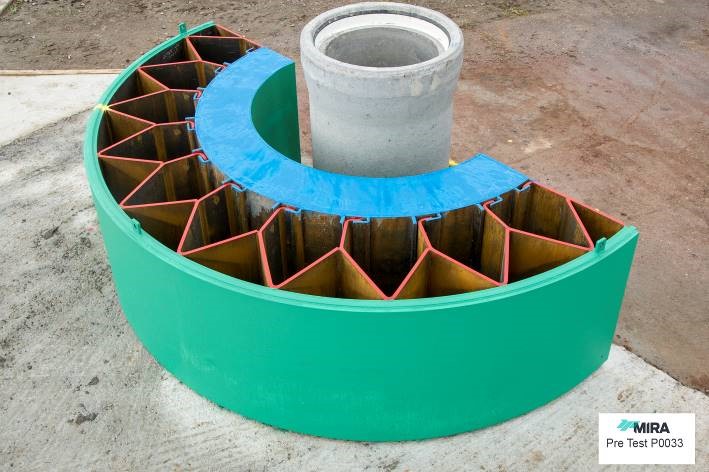
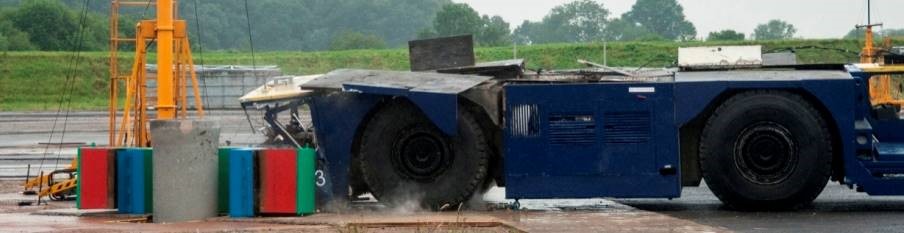
MIRA (Motor Industry Research Association) in the UK then validated and verified the modelling through a full-scale independent impact test.
Following the successful test at MIRA, engineers incorporated the site-requirement options into the modified design. They then analysed this design using ABAQUS across a series of impact events to validate its impact resistance.
In all cases, the system foundations remained independent of the columns, grade beams, pile caps, and, where specified, the suspended slabs.
Engineers designed the system to minimise disruption to airport operations should an impact occur. A removable energy-absorption cell makes this possible: crews can readily replace it after a severe collision.
The reaction wall and foundation, by contrast, are unlikely to need replacement for the designed impact event.
Engineers designed the SPS protection system around an energy-absorbing structure. Ten Y-shaped steel stiffeners and a reinforced reaction wall behind it provide support.
To prove the design could perform under real-world conditions, engineers modelled a 70-tonne tow vehicle. It travelled at 8.33 m/s, or around 30 km/h, and struck the system with an impact energy of 2,430 kJ.
Engineers then tested the system against impacts at several different points. The resulting analysis showed that the SPS structure absorbed the vehicle’s impact energy through controlled deformation.
This successfully prevented the vehicle from reaching the wall behind it.
If you have a similar project, or need to protect critical infrastructure from high-impact loads or dropped objects, speak to a member of the SPS Technology team today.


For the latest on our ground-breaking technology, follow the SPS Technology LinkedIn page and subscribe to our YouTube channel.

© 2026 SPS Technology. Web Design & Marketing by Five O’Clock Creative.


