
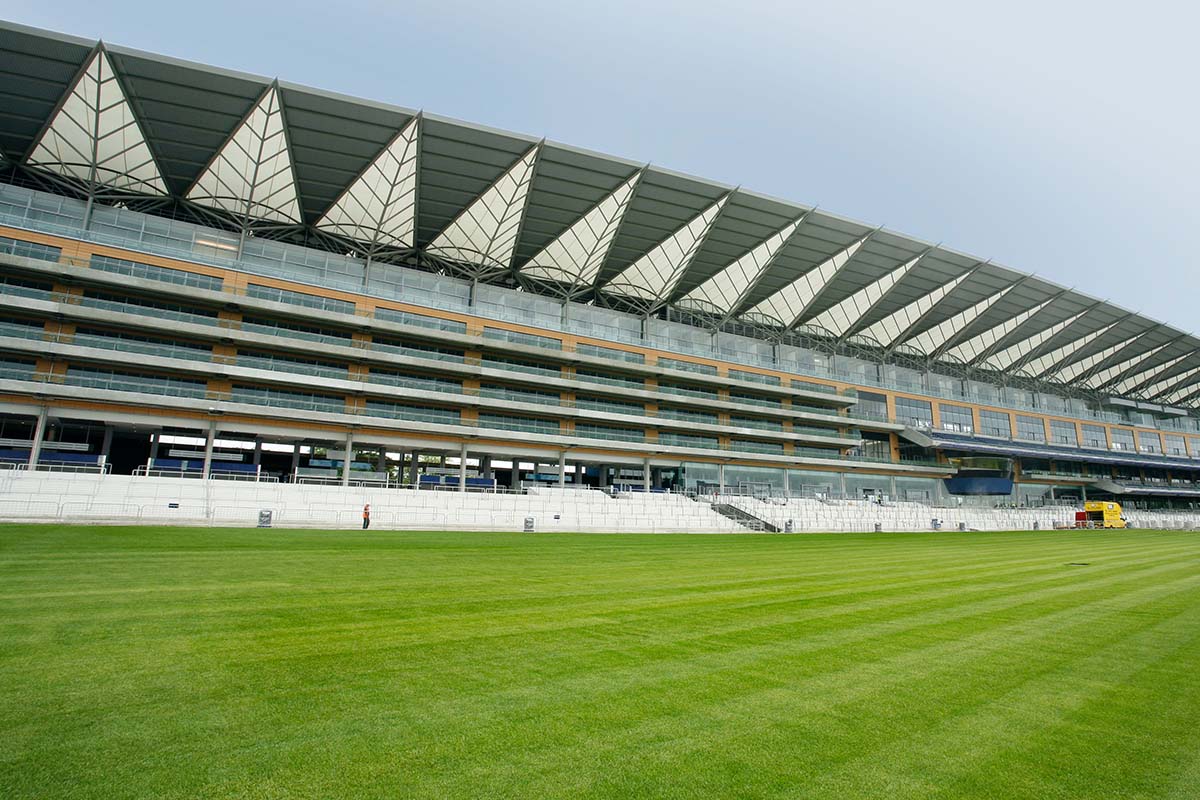
Ascot Racecourse Grandstand Terrace Reprofiling
Project Type
Grandstand Terrace Reprofiling
Location
Ascot, Berkshire, UK
Date
2007
Team
Stanhope
HOK Sport (now Populous)
Buro Happold
McArdle Group
EDS
MAPSS

Grandstand Terrace Reprofiling
Ascot, Berkshire, UK
2007
Stanhope
HOK Sport (now Populous)
Buro Happold
McArdle Group
EDS
MAPSS

Ascot Racecourse’s £200m redevelopment in 2002–2004 left the lower grandstand terrace with poor sightlines during Royal Ascot. To fix this, the design team made a visionary choice to reprofile the terraces using Sandwich Plate System, building directly over the existing structure. As a result, Ascot became both the first SPS Stadia + Arenas System project and our first terrace “overbuild”.
Royal Ascot is one of the most anticipated and significant events in the UK’s summer sporting calendar. However, its strict dress codes dictate gentlemen wear traditional top hats and ladies wear hats throughout the week.
Because of the added height of the top hats, the redevelopment failed to offer unimpeded views of the action on the racecourse. Racegoers on the ground blocked the view of those in the stands, while bookmakers’ boards and umbrellas further obstructed sightlines during Royal Ascot.
Rather than pursuing more invasive solutions, such as lowering the racetrack or demolishing the newly built stands, the design team instead chose to use Sandwich Plate System. Recognising the possibilities it offered, the team took a calculated risk and reprofiled the concrete stands with SPS Technology’s innovative ‘overbuild’ system.
Following its success in the Maritime industry, SPST engineers had already begun investigating Sandwich Plate System for bridges and stadia terraces. Its proven ability to absorb vibration, combined with its comparitively light weight, made SPS a natural fit for both applications.
At Ascot, the design team reviewed the use of concrete overlay solutions but those were too heavy. When SPS was suggested it solved a number of the challenges at Ascot:
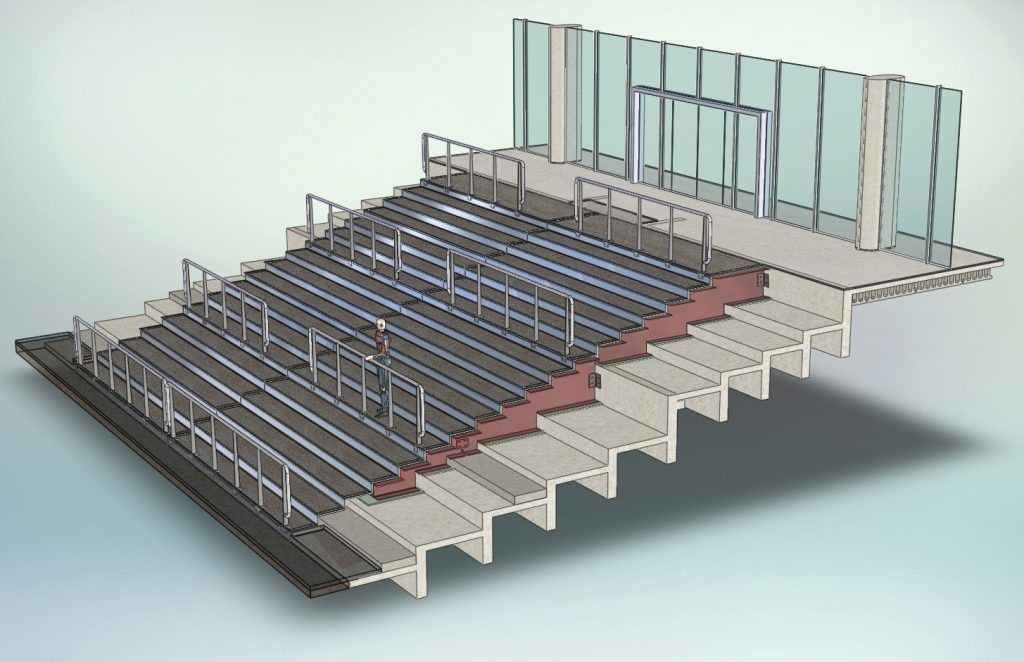
By utilising 3,250m² [35,000 ft²] of SPS, the team increased the rake of the grandstand terraces by almost one metre. Of this, 2,600m2 [28,000 ft²] is continuous standing terracing in 10.5m [34.5 ft] spans supported on steel support stools. Because SPS terracing is so lightweight, builders could install it directly on the existing structure without demolition.
The terraces were manufactured in Hanover, Germany and installed as ‘triple’ units, three terraces in each crane lift. Ultimately, the renovation work was completed in four and a half months in time for the summer season.


”There is no doubt that SPS terraces provided the right solution for our tight timetable. SPS Technology and its partners delivered all that we were looking for.
Charles BarnettChief Executive, Ascot Racecourse
We are impressed with the high quality finish and performance of the SPS terraces and delighted that they met with the approval of our customers at Royal Ascot this year. With such obvious speed and quality advantages, SPS terraces must have a strong future in the stadium industry.
Two decades since this first project, the SPS Stadia + Arenas System has changed considerably in its design, detailing and installation. Unique in the stadium renovation market, we’ve gone on to do many reprofiling projects at high-profile venues around the world.
Have a look at our overbuild project at ACU Moody Coliseum, a historic indoor venue in Abilene, TX. Or the outdoor reprofiling at Delaware Stadium on Youtube
For the latest on our ground-breaking technology, follow the SPS Technology LinkedIn page and subscribe to our YouTube channel.

© 2026 SPS Technology. Web Design & Marketing by Five O’Clock Creative.


